The Altitude Retreat
Twenty-four hours in the Lake District, and the six weeks after. Then they’re the same person.
Home when you said you’d be home. Focused when it counts. The temper felt early enough to do something about it.
Not more resilience. An operating system that honours what you say you want.
Your assistant and your partner have a dedicated number throughout, monitored by my team. You are not out of contact. You are out of reach of everything that is not an emergency.
01 · The gap
You know who you want to be. The leader. The spouse. The parent. There is that man, and then there is the one who walks through the door at seven. The distance between those two is what stress actually is.
You know what it looks like from the inside. Tired all day and then wide awake at three. Running on autopilot, and some days you could not tell me what you did. Coming home like a bear with a sore head, and then not being able to cope with the noise once you are in it. Habits you do not like and cannot seem to put down.
It did not happen in one decision. It was the fifteen minutes late, the call taken at bath time, the promise quietly renegotiated. Each one affordable on its own. The account empties anyway.
None of that is weakness. You have not run out of discipline and you are not failing at something other people find easy. You have been solving the wrong problem, carefully, for a very long time.
02 · Why it has not held
You have read the books. You have done the courses, probably more than one, and some of them were good. You came out with better language for it, and by Wednesday nothing had moved.
That is not a failure of the books. The brain is a chat room, not a boardroom. It is where the conversation happens. It is not where the decisions get made.
So twenty years of work went into improving the quality of the conversation, in a room that was never running the place. Clear thinking is a physical event. Your body is holding the other half of it, and until both halves are worked together, insight keeps evaporating.
That is what neurosomatic means. Most coaching takes the first half only, which is dialogue. The whole system includes the body.
And the aim is not resilience. Resilience asks you to withstand more of the same, and you have been doing that for twenty years. The stressors are not going to stop arriving. What changes is that you find where the accelerator is, and where the brake is, and how to use either one on purpose.
03 · Why it happens away
This is the part that gets misunderstood about going away. It is not the scenery, and it is not a break.
You are not separable from the environment you sit in. The office, the commute, the kitchen at half past seven, the phone face down on the side. They are not the backdrop to how you operate. They are part of how you operate, which is why a quiet weekend does so little. You are still in range, and your body knows it.
So the work happens out of reach of both of them. Far enough that nobody can get to you and you cannot get to anything. The phone goes into a box on arrival. That is usually the first time in years the system has had no reason to brace, and clients tell me they slept more deeply that night than they had in a very long time.
That is the mechanism. The Lake District is simply where it is far enough.
The Lake District
04 · The twenty-four hours
About the box. A Faraday box is lined so that no signal reaches the phone. Not face down on the table, not switched off in a drawer where it is still three feet away and you still know it is there. Actually out of reach.
Before you travel, your assistant and your partner are given a dedicated number, monitored by my team for the whole twenty-four hours. Anyone who genuinely needs you can have you within minutes. Nobody else can reach you at all.
That is the part people underestimate. You are not out of contact. You are out of reach of everything that is not an emergency, which turns out to be almost all of it.
This is not a test of willpower, and it is the part people are most surprised by. In 2012 researchers at the universities of Kansas and Utah gave a creative reasoning task to fifty-six adults on wilderness expeditions. The group four days in, with no devices at all, scored around fifty per cent higher than the group who had not yet set off. The researchers were careful to say they could not separate the effect of being in nature from the effect of being away from screens. Here you get both.
Atchley, Strayer and Atchley, Creativity in the Wild, PLoS ONE, 2012.
05 · Afterwards
The twenty-four hours is not a taster, and the six weeks after it is not a shortened programme. Together they do more than six months of ordinary coaching would, and the reason is attention.
Ordinary coaching is an hour somewhere in a week that is already full. You arrive from one meeting and leave for another, the first ten minutes go on catching up, and whatever you reach has to survive on its own until the next one.
This is twenty-four hours with nothing else in them. No phone, nobody to get back to, and the whole of it pointed at what is actually slowing you down. Then six weeks of keeping it moving while it is still warm.
One call a week, forty-five minutes, booked by you when you want it. A short prompt most days in between.
One call a week is deliberate. Being permanently available is a large part of what got you here, and I am not going to sell it back to you as support. The daily prompt does the holding. The call does the work.
Included: the car from the station, lunch on arrival, your room for the night, dinner, breakfast, and the room kept after checkout. You get yourself to the station. Everything from the platform onwards is mine.
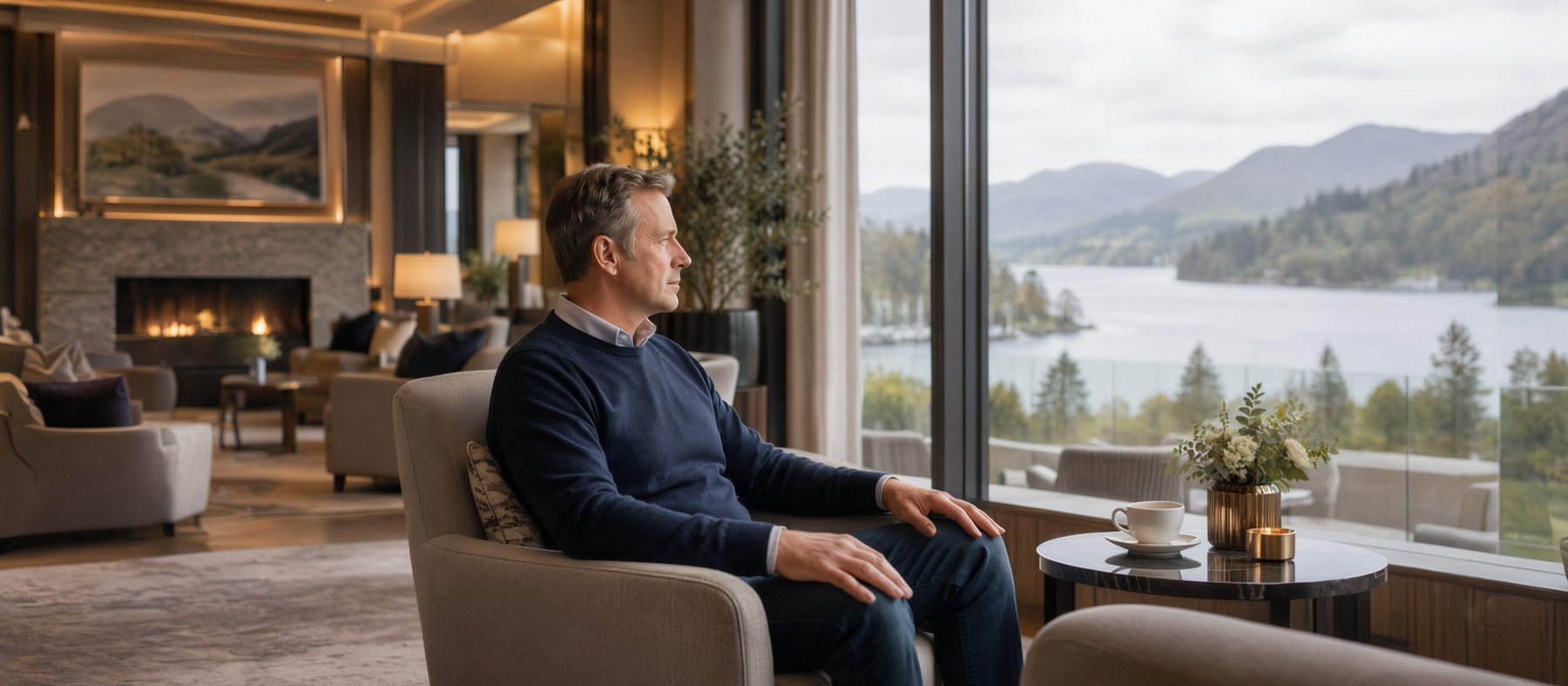
You will stay at a country house hotel on Windermere.
Some people carry on with monthly work once the six weeks are done. That gets decided then, not now.
06 · Who this is for
Founders, chief executives, directors and partners. Also the person building something at four million who is still working the way he worked at four hundred thousand, and has started doing the arithmetic on how long that lasts.
The size of the business is not the point. The question is whether the way you are running yourself has started to cost more than it returns, at work and at home.
It is not for anyone in crisis. If that is where you are, your GP first, and this alongside it rather than instead of it.
07 · The founding six
The full programme is £15,000: the retreat and six weeks of work.
Six founding places are open below that. Each one is the twenty-four hours and the six weeks that follow.
Two conditions, and they are the whole of it.
Your twenty-four hours takes place in November or December. No date is fixed when you book: once your place is confirmed, I work with our partner hotels around Lake Windermere to find a date that suits you.
And afterwards you give me a short video, saying where you were before and where you are now. Honestly, whatever it says.
This will not be repeated at these prices.
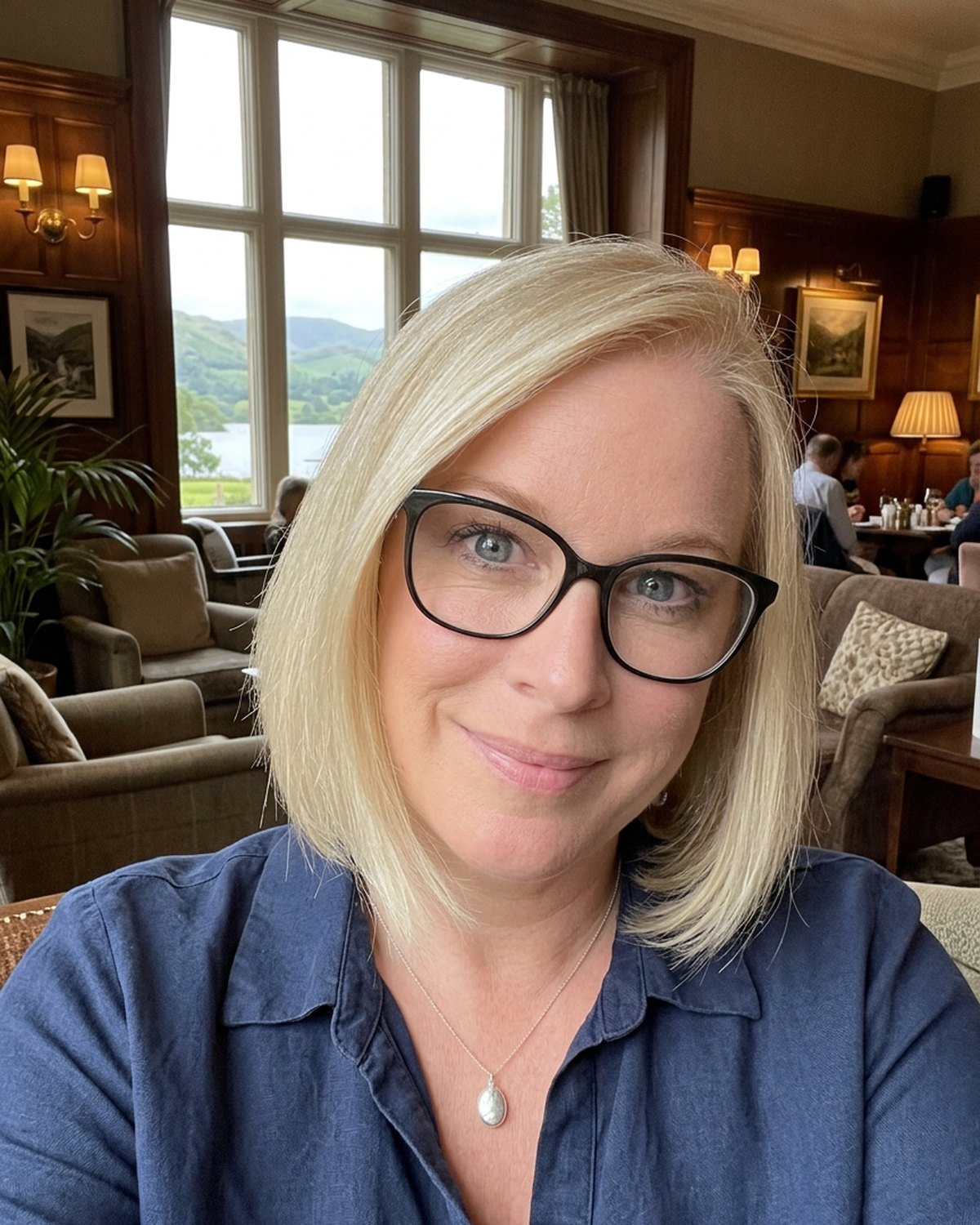
08 · Who I am
I started in corporate in the 1990s, at BUPA, running national occupational health programmes for large employers and leading clinical teams of around a hundred people. Much of the FTSE was on those programmes, with well over a million employees between them.
Then I built my own occupational health and wellbeing business and ran it for fifteen years. It began as me, a full-time nurse and a part-time doctor, funded entirely by me, and grew to a team of more than a dozen serving household names. A great deal of that work was stress.
I am not a clinician. I employed them.
Seventeen years of coaching since, most of it with senior leaders. For years I worked with mindset alone. It took people a certain distance and then stopped, and I could not explain why an insight that landed in a session had gone by Tuesday. The body was the missing piece.
Qualified in somatic coaching, NLP, and life and business coaching. Currently studying ontological coaching and fascia work.
09 · The next step
Fifteen minutes. Bring the thing that is stopping you. No pitch, and nothing is decided on the call.
If the retreat is not the right thing for you, or not the right time, I will say so.
This is coaching and psychoeducation. It is not therapy and it is not medical care, and I will never advise you on medication. If you are in crisis or at risk, contact your GP, and we can work alongside that.